Hapkido is rooted in Korean martial traditions and Japanese influences such as Daito-Ryu Aiki Jujitsu, transmitted by Sokaku Takeda and learned by Choi Yong-Sool.
Origins and Founder
Hapkido was founded by Choi Yong-Sool in the 1940s, after his return to Korea from living in Japan. Choi was a student of Sokaku Takeda, a master of Daito-ryu Aiki-jujitsu, and adapted the techniques he learned, combining them with elements of traditional Korean martial arts such as taekkyeon. This martial syncretism not only enriched hapkido technically but also helped restore the cultural pride of the Korean people after the Japanese occupation (1910-1945).
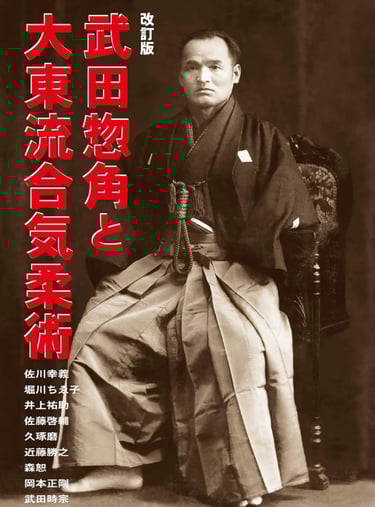
Grandmaster Choi Yong Sul (1904-1986) was born in Chungbuk, Korea. In 1912, at the age of eight, during the Japanese occupation of Korea, Choi was taken to Japan by a Japanese confectioner, Ogichi Yamada, who was returning to his homeland. Choi Yong Sul was an orphan, and the (apparently informal) adoption attempt by Yamada and his wife was unsuccessful. After living with them for three years, and due to Choi's difficult temperament, the Yamadas abandoned him, somewhat wistfully, at a Zen Buddhist temple. The young Choi spent two years at the temple under the care of the monk Kintaro Wadanabi, but Choi's restless nature was not well-suited to a peaceful religious life. The monk asked him what he wanted to do with his life. The thirteen-year-old Choi pointed to the images of warriors that covered the temple walls. At that time, many samurai warriors, following ancient traditions, made annual pilgrimages throughout Japan to give thanks and improve their skills. During these journeys, they visited local temples to offer prayers and donations. On one of these occasions, the monk presented Choi as a servant to a feudal lord and samurai he knew: Master Sōkaku Takeda, the leader of the Takeda feudal clan. Master Sokaku Takeda resided at Daitō Castle and was the last master (soke) of the martial tradition of Daitō-ryū aiki-jūjutsu, the sole heir of the thirty-seventh generation (37) of the art, and also a master of classical Japanese swordsmanship, or kenjutsu, of the Ona-ha Itto-ryū Kenjutsu style.
It was 1917, and Master Sōkaku Takeda, realizing he could not educate a banished Korean boy among the elite kuge nobility or the samurai warriors of his clan, had Choi adopt the name "Asao Yoshida," given to him by his first adoptive father in Japan. He forbade him from using Korean customs and language to prevent discrimination from his peers. With time, obedience, great effort, and immense sacrifice, Asao Yoshida earned the respect of the Takeda family and his master, whom he accompanied to numerous exhibitions and fights as they traveled throughout the country, witnessing many of the challenges issued by various mercenaries, masterless samurai (ronin), and other samurai warriors. During World War II (1939-1945), Master Sōkaku Takeda and Asao Yoshida were employed by the Imperial Japanese Army to capture numerous army deserters and bandits who were hiding in the mountains of Japan. Choi came to regard Master Sōkaku Takeda as his surrogate father (referring to him as such in several interviews) even years after the death of the famous Daitō-ryū Aiki-jūjutsu master.
After the death of Soke (headmaster) Takeda in 1943 (according to Choi, Master Sōkaku Takeda died of starvation, due to the shame he felt because Japan was losing the war) and after the end of World War II in 1945, Asao Yoshida returned to his native Korea, specifically to the city of Daegu (North Gyeongsang Province), reverting to his Korean name, "Choi Yong Sul." In Korea he started a new life raising pigs and working in the fields.
In his region there was a brewery that used its discarded peat to feed the pigs. When animal feed was distributed, because the brewery used water from a nearby well, and since there were no aqueducts at the time, arguments often broke out among the various farmers, as some offered to fetch water from the well, losing their place in line. One day, this led to a fight at the brewery, during which the manager noticed how easily Choi dispatched his opponents. After requesting to see him in his office, the manager asked Choi to teach his techniques to his son, who was the manager in charge and whose name was Seo Bok-Seob (and who at that time practiced Judo, even holding a 1st dan rank). Seo Bok-Seob became one of Choi's first disciples and later one of the first Hapkido masters.
From then on, Choi and Seo began developing a self-defense method based on a combination of the classical Japanese martial art of Daito-ryu Aiki-jujutsu, the then-traditional martial art of Judo, and techniques from Korean martial dance or Taekkyon (the basis of modern Taekwondo), which is distinguished by its numerous kicking, foot grabs, and sweeping techniques. They initially called this new system Aito Ryo-Yu Kwon Sul. Later, Ji Han Llae joined their classes, and with contributions from him and Seo, Bok Seob registered the International Hapki Yuk Won Sool Association as the organization that taught Choi Yong Sool's art in 1953. Aito Ryo-Yu Kwon Sul was taught in the early 1960s to masters such as Hwang In-shik, Ji Han Llae, and Le Dong Koo. Myung, Deuk Suh; Kim, Sung Kiong; Seo, Bok Seob; Suh Bok Seob; Kim, Myung Yong; Bong Soo, Han Kim, Tae Ho;... among Choi's most important disciples.
Grand master Seo, Bok Seob
Seo Bok-seob was the first to learn the teachings of Grandmaster Choi Yong Sul, with whom he founded the first dojang of the art in 1951, called Daehan Yong Sool Kwan (대한합기유권술도장), in Daegu, South Korea. This occurred after he witnessed Grandmaster Choi successfully defend himself near the Seo Brewery Company. Following the incident, Seo and other factory workers prepared a training room, or dojang, in a warehouse, where they began training.
Since Grandmaster Seo came from a wealthy and politically active family in his region, he received an excellent education, even graduating from a prestigious university in Japan as an exchange student. This was a privilege afforded to only a few at the time. Under Japanese occupation (1910-1935), he studied the then-Japanese martial art of Judo and even achieved his first-degree black belt under the Korean master Yong Ho Choi at a very young age. Grandmaster Seo, as a member of a prominent family, was given positions of authority from a young age and became the founder and director of a rice wine distillery. Grandmaster Seo's father was a congressman in the new Korea after the war and employed Grandmaster Choi and other early practitioners of Hapkido as his bodyguards, including Ji Han Llae.
Currently, the president of the Korean Hapkido Federation is Grand Master In, Seo Lim.
It is important to note that Grandmaster Ji Han Jae was a student of both Grandmaster Choi and Grandmaster Seo Bok Seob, who held a higher rank and was his superior at the dojang. In 1956, Ji Han Jae finished his studies and moved back to An Dong, his birthplace. There, he decided to continue his training and was accepted as a disciple of the Taoist monk Lee Do-Sa in the art of Taekkyon. He also received instruction from a nun who was an expert in Son Do Sul. It was then that he decided to open a Yuk Kwan Sool school in his hometown, which he named An Moo Kwan. He was a great practitioner of all kinds of kicking techniques and even developed the 360° roundhouse kick, which he called Dora Chagui. Among his first students were Kwon Tae-Man, Yu Yong-Wu, and Suh, Seo Lim.
After Ji Han Llae registered the International Hapki Yuk Won Sool Association as the Korean Kido Association, Master Ji Han Llae suggested that his teacher Choi lead the organization. The International Hapki Yuk Won Sool Association was the first organization accepted by the Korean government for the dissemination of Choi Yong Sool's art. The fact that the association created by Ji Han Llae offered no compensation for its leadership led Ji Han Llae to become independent. He created his own school and named it Sung Moo Kwan.
Grand Master Seo designed the organization's first symbol, which consisted of two arrowheads meeting inside a circle. The circle represents the universe, within which is humankind. The arrowheads signify union, the meeting of opposites, of hard and soft, yin and yang, all in a cycle of constant change and balance or harmony. This emblem is still in use by the International Korea Kido Association, the World Kido Association, and the World Hapkido Federation cuya presidencia asume hasta 2015 Kwang-Sik Myung siguendo la escuela Sung Moo Kwan de su maestro y amigo Ji, Han Llae.
Furthermore, Grandmaster Seo, who had incorporated numerous throwing techniques (nage-waza), ground fighting techniques (ne-waza), joint lock techniques (kansetsu-waza), and various strangulation techniques (shime-waza) into the art of Choi, derived from the then-Japanese martial art of Judo, which he had practiced in his youth, seeing that he was not being rewarded for creating a common structure for the final program of the newly formed association, decided to separate from the organization and create the International Korean Yuk Sool Woon Association que dirigió hasta 2005, who as we said in previous paragraphs was led by Kim, Tae Ho after 2005.
It is important to note that Grandmaster Ji Han Jae was a student of both Grandmaster Choi and Grandmaster Seo Bok, Seob; who held a higher rank and was his superior at the dojang. In 1956, Ji Han Jae finished his studies and moved back to An Dong, his birthplace. There, he decided to continue his training and was accepted as a disciple of the Taoist monk Lee Do-Sa in the art of San-Taekyon. He also received instruction from a nun who was an expert in Son Do Sul. It was then that he decided to open a Yuk Kwan Sool school in his hometown, which he named An Moo Kwan. He was a great practitioner of all kinds of kicking techniques and even developed the 360° roundhouse kick, which he called Dora Chagui. Among his first students were Kwon Tae-Man, Yu Yong-Wu, and Oh Se-Lim.
The International Hapkido Yuk Won Sool Association (the first organization accepted by the Korean government for the dissemination of Choi Yong Sool's art). The fact that the association created by Ji Han Llae received no compensation for its leadership led Ji Han Llae to become independent. He founded his own school and named it Sung Moo Kwan.
Grandmaster Seo designed the organization's first symbol, which consisted of two arrowheads meeting within a circle. The circle represents the universe, within which is humankind. The arrowheads signify union, the meeting of opposites, of hard and soft, yin and yang, all within a cycle of constant change and balance, or harmony.
This emblem is still in use by the International Korea Kido Association, the World Kido Association, and the World Hapkido Federation. Likewise, Grandmaster Seo, who had incorporated numerous throwing techniques (nage-waza), ground fighting techniques (ne-waza), joint lock techniques (kansetsu-waza), and various strangulation techniques (shime-waza) into Choi's art, all derived from the then-Japanese martial art of Judo, which he had practiced in his youth, seeing that he was not being rewarded for creating a common structure for the final program of the newly formed association, decided to separate from the organization and create the Korean Yuk Sool Woon Association. Grandmaster Seo Bok Seob dedicated himself entirely to traditional Eastern medicine, becoming a university professor in Seoul specializing in sports massage and osteopathy (manual therapy). He led the International Korean Yuk Woon Sool. assocciation. Grandmaster Ho, Kim Tae, took over the organization since this day until 2015. Grand Master Kim Sung, Kiong is its current president.
The Gran Master Suh, Bok Seob
Grandmaster Suh, Bok Seob (brother of Seo Bok Seob) trained at a young age in the dojang of Kim Sung's father, Kiong, who was a master of Chinese Boxing. Along with Kim Sung, Kiong, he entered the dojang of Le Dong Koo, where Kim Soon (Claudino Covela's teacher) and Bae Jeoung Young (my Hapkido teacher) were students. Years later, Le Dong Koo decided to go to Spain to spread Hapkido under the Korean Yuk Sool Woon Association, which was directed by his brother Seo Bok Seob. Suh Bok Seob and Kim Sung Kiong went with him via Japan. A brief stay in Japan led to an encounter with Myung-Deuk, Suh [(a student of Master Seo Weok Limg (Seo Weok Limg, Morihei Uesiba, and Choi Yong Sool were students of the Grand Master Samurai Sogaku Takeda)].
Myung-Deuk, Suh, of Korean origin, befriended Suh, Bok Seob, Kim Sung, Kiong, and Le Dong Koo, and they traveled to Spain. They settled in the Pontevedra town of Villagarcía de Arosa, where they opened a dojang. Shortly after, they opened another dojang in Cangas del Morrazo (opposite Vigo).
Around that time, Suh Bok Seob opened a gym in Cangas del Morrazo with Myung-Deuk, Suh, and Le Dong Koo himself. Master Kim Soon opened a gym in the town of O Carballiño (Ourense) in 1983. Masters Kim Sung, Kiong, and Le Dong Koo traveled to Ontario. (Canada) in early 1984.
Myung-Deuk, Suh continued teaching Hapkido and Kempo Karate-do at the dojang in Cangas del Morrazo.
Master Suh, Bok Seob, began to gain considerable influence among the Spanish Taekwondo instructors, who enthusiastically requested that he conduct Hapkido seminars. After the death of Le, Dong Koo, the International HoShin Hapkido Association, and especially after the struggle to secure leadership of the IHF following Myung's death, Llae Nam generated great hope. Many instructors who had emigrated from Korea reunited and established agreements for generational succession in the various Hapkido schools that were heirs to the original school of Choi Yong Sool (defined in the International Hapkido Yuk Won Sool Association, currently presided over by Ho, Kim Tae).
In 2005, after a period in Canada, he decided to leave. He went to Korea. There, seeing how generational succession was taking place in all the major hapkido schools, he decided to take the reins of his brother Seo Bok Seob's association (International Yuk Sool Won Association), while Kim Tae Ho presided over the International Korean Hapkido Association, which was headquartered in Seoul, Korea. Meanwhile, Le Chan Soo decided to create the International Jin Jung Kwan Association, based in France.
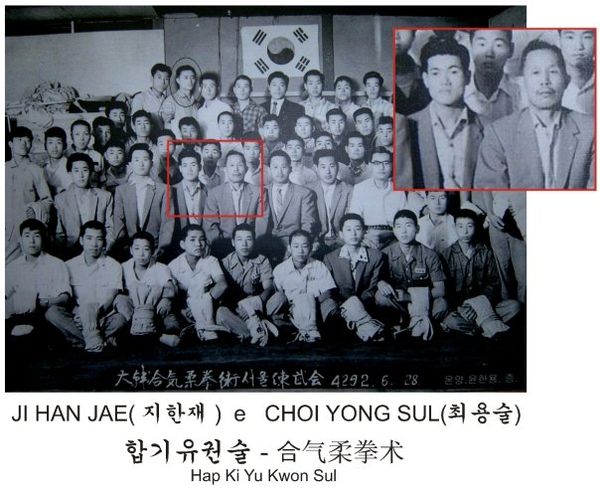
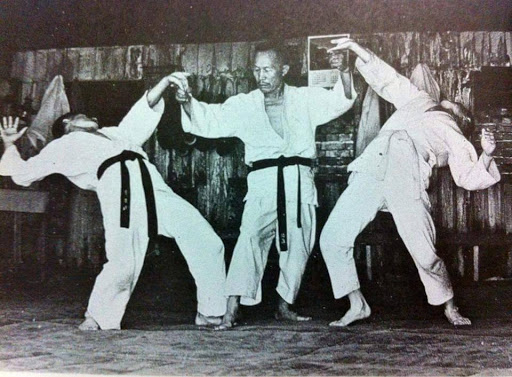
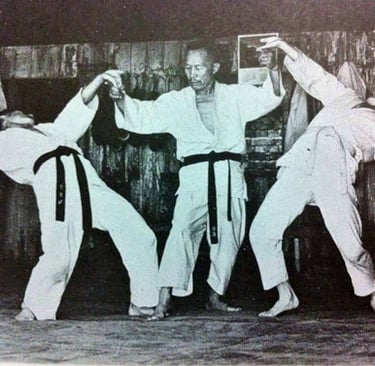
Choi Yong Sool with
Ji, Han Llae and Kim, Tae Ho
Remember that the students of the "Great Last Samurai" Sogaku Takeda, Choi Yong Sool, Peter, Seo Lim, and Morihey Ueshiba created (with their students) the martial arts Hapkido, Kempo Key Do, and Aikido..
In ancient times, martial arts were known, and thanks to films featuring Jet Li, Bruce Lee, David Carrandine, Steven Seagal, and Jackie Chan, we nostalgically and romantically believe that there was a time when people worked on their body, soul, and spirit, using martial arts not only for self-defense but also for self-discovery. They sought to raise the bar for human capabilities, drawing on their ancestral intelligence and wisdom, guided by principles that lead those of us who practice martial arts to see this practice as a way to bring out the best in ourselves and value our own lives, the lives of others, and nature. We strive to improve every day, believing that if you go to bed reflecting on the day without having learned something, it's something that makes you feel you have honored your ancestors, friends, family, and teachers, and therefore consider your work for that day fulfilled.
The Gran master Suh, In-Hyuk.
He studied from a young age with his grandfather, the same one who taught Le Dong Koo and Grandmaster Suh Bok Seob. Together they entered the Hapki Yu Kwon Sool academy. Masters Le Dong Koo and Suh Bok Seob emigrated to Spain along with other masters, students of Choi and students of Grandmaster Peter Seo-lim, such as Grandmasters Myung Deuk Suh, Kim Sung Kiong, and Kim Myung Yong.
Later, in Canada, Myung Deuk Suh, along with Suh In-Hyuk and Le Dong Koo, embarked on the adventure of creating the International Hoshin Hapkido Federation. The death of Suh's grandfather, In-Hyuk made him decide to return to Korea where, In the 1990s, Grandmaster Suh In-hyuk immersed himself in the knowledge of Korean martial arts, which are divided into three main branches:
Tribal Martial Arts (사도무술; 師徒武術; Sah Doh Mu Sool).
Buddhist Temple Martial Arts (불교무술; 佛敎武術; Bul Kyo Mu Sool).
Royal Court Martial Arts (궁중무술; 宮中武術; Koong Joong Mu Sool).
He also incorporated knowledge gained from his various trips to Shaolin temples (the birthplace of Wushu, or Chinese Kung Fu). He is currently the president of the international World Kuk Sool Hapkido Association (https://www.kuksoolwon.info/kuk-sool-won/grandmaster/).
The Gran Master Lee Chang Soo
He began practicing Jin Jung Kwan Hapkido in 1964, at the age of 14, at the Wangshimri Gymnasium in Seoul, under the tutelage of Master Kim Myung Yong (current head of the Jin Jung Kwan school and 9th dan in Hapkido). In June 1976, he became the middleweight champion at the first Korean Hapkido Championship. In October of that same year, he joined the demonstration team of the Korean Hapkido Federation. In 1975, Kim Myung Yong emigrated to the United States and entrusted the leadership of the Jin Jung Kwan school to Lee Chang Soo.
In 1984, this team undertook a major demonstration tour of East Asia (Singapore, Hong Kong, and Indonesia). In 1985, Grandmaster Lee Chang Soo was appointed captain of the national demonstration team and conducted a hapkido demonstration tour of the 50 largest cities in Korea (Seoul, Busan, Daegu, Incheon, etc.). In 1986, he conducted a seminar for the sheriffs of Korean Air Lines. In 1987, he conducted a seminar for the Seoul police in preparation for the Olympic Games.
In 1990, Grandmaster Lee Chang Soo was appointed examiner for the Police Academy for hapkido rank evaluations. The Jin Jung Kwan style is characterized by its extremely dynamic, hard, and forceful techniques. In 1976, Grandmaster Kim Myung Yong emigrated to the United States and entrusted the leadership of the Jin Jung Kwan school to his best student, Grandmaster Lee Chang Soo, who would be responsible for making Jin Jung Kwan Hapkido one of the most respected styles of Hapkido worldwide.
Grandmaster Lee Chang Soo competed extensively to demonstrate the merits of his Hapkido style, while also working regularly with other masters of the Korean Hapkido Federation. He attended all the masters' courses and meetings, accumulating training and knowledge. In 1985, he was appointed coach and selector of the Korean Hapkido Federation's demonstration team.
His presence at numerous demonstrations, providing training to Korean SWAT teams, the Korean army, and special forces units from other countries, was a constant throughout his career. Thanks to Grandmaster Lee Chang Soo's hard work and dedication, Jin Jung Kwan schools can now be found in South Korea, France, Spain, the Netherlands, Portugal, Canada, Switzerland, Brazil, Hungary, Tahiti, and Morocco. That same year, the Korean Hapkido Federation appointed him president of the jury for the 1st to 7th dan examinations.
In 1993, he was appointed Grandmaster of Public Institutions by the government. On July 27, 1993, the Korean Hapkido Federation awarded him the rank of 8th dan. Currently, the Jin Jung Kwan Hapkido school is taking over the World Hapkido Federation of Grand Master Kwang-Sik Myung; that is, this school manages the International Korean Hapkido Federation, which until then had been the school absorbed by Kwang-Sik Myung and created by Grand Master Ji Han Ilae.
The Grand master Kwang-Sik Myung
El Gran maestro Kwang Sik, Myung
Grandmaster Kwang Sik Myung began his Hapkido training with Ji Han Jae in Soul in 1957, where he practiced with other renowned masters and instructors such as Lee, Tae Joon, Kang, Jong Soo, Kim, Yong Jin, Kim, Yong Whan, and Hwang Duk Kyu, who later became president of the Korean Hapkido Association.
He graduated from Sung Kyon Kwon University with a degree in Commerce, during which time he received instruction from Grandmaster Choi Yong-Sul.
After graduation, Kwang Sik Myung was appointed head of the Northern Branch Hapkido Dochang. Following his involvement with the Korean Hapkido Association, then led by Ji Han Llae, he sent 15 members of a demonstration team to Vietnam and taught Korean, American, and Vietnamese troops, as well as Special Forces.
Upon returning to Seoul, he continued training with Ji Han Llae. There was Myung, Llae Nam. Kwang Sik Myung opened a school in the Sansunkyo district and established the Korean Hapkido Association Yon Moo Kwan in April 1968, dedicated to promoting Hapkido as a highly visible martial art.
In 1968, at the age of 27, he published a 254-page book in Korean, "Hapkido." This was followed by the first major Hapkido book in English, "Hapkido – Ancient Art of Masters" (October 1976).
He then moved to Detroit, where he opened his first Hapkido school and formed the World Hapkido Association with Ji, Han Llae, having settled there after his time in Germany.
Shortly after, in 1976, he published one of the first and most detailed books on Hapkido technique in English available to date, improving upon the material in his earlier book published in Korea. Myung later moved its headquarters to Los Angeles and established the World Hapkido Federation. While in Los Angeles, Myung produced and published a large number of Hapkido videos and books.
Lee, Tae Joon; Kang, Jong Soo; and Kim, Yong Jin are part of the current leadership of the World Hapkido Federation. They, along with American James S. Benko, lead the organization, which has been dominated since 2015 by the Hapkido Jin Jung Kwan school of Le Chan, Soo. Prior to that, the school followed the style of Ji, Han llae (Sim Moo Kwan).
The Grand Master Ji, han Llae
He began his martial arts training, specifically in Yu Kwan Sul, in 1949 under the supervision of Choi Yong Sul, who lived next door. He lived in Daegu and combined his training with his university studies. He trained with him for about four years. The training was very rigorous, but it was a way for the students to demonstrate their loyalty and spirit of sacrifice to Master Choi. At the end of his training, Ji Han Jae was appointed first assistant and most advanced student, and he earned his black belt in Choi's Yu Kwan Sul Aiki.
When he finished his studies in 1956, he moved back to An Dong, the village where he was born. There, he decided to continue his training and was accepted as a disciple of the Taoist monk Lee Do-Sa in the art of Taekkyon. He also received instruction from a nun who was an expert in Son Do Sul. It was then that he decided to open a Yu Kwan Sul school in his hometown, which he named An Moo Kwan. He was a master of all kinds of kicking techniques, and even developed the 360° roundhouse kick he called Dora Chagui. Among his first students were Kwon Tae-Man, Yu Yong-Wu, and Oh Se-Lim.
After a little less than a year, he traveled to the capital, Seoul, where he established his school called Sung Moo Kwan, joined by Grandmaster Myung Llae Nam. A few months later, after a split with his teacher Choi Yong Sool, the school was moved to the Jung Bu Shi Jang district.
In 1959, the grandmaster decided to change the name of Hapki Yu Kwan Sul to Hapkido, an art he had developed from the teachings of Choi Yong Sul, taekkyon kicking techniques, weapons training, and the development of internal energy derived from his training in Son Do Sul. His students included Hwang Duk-Kyu, Kwang-Sik Myung, Kim Yong-Jin, and Jung Won Sun, and later also Han Bong Soo, Choi Sea-Oh, and Myung Jae Nam.
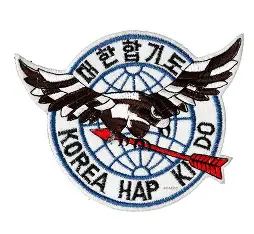
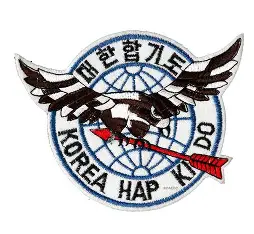
It was during this period that the Hapkido emblem was chosen, giving its name to the organization led by Ji Han Llae: the Korea Hapkido Association.
Before leaving South Korea, Myung Jae Nam, then president of the International Hapkido Association, awarded Ji Han Jae his 10th Dan. Ji left Korea in April 1984 and traveled to Germany before emigrating to the USA. He settled in Monterey, California, where he founded the World Hapkido Federation. In the mid-1990s, he expanded the techniques that defined his school to found the Sin Moo Hapkido Association. Today, the Doju-Nim Ji Han Jae is under the jurisdiction of the World Sin Moo Hapkido Association, headquartered in Switzerland.
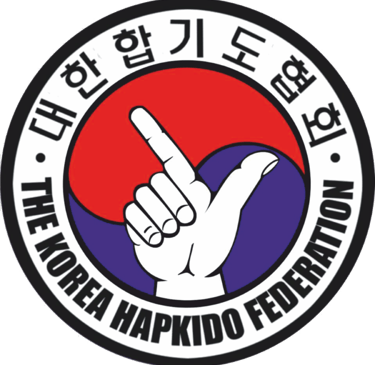
At that time, the Korea Hapkido Federation, following Ji Han Jae's style (Sung Moo Kwan), adopted the following emblem:
The Grand Master Bong Soo, Han
Bong Soo, Han (August 25, 1933 – January 8, 2007) is known as the father of hapkido in the United States. A martial arts instructor, writer, and founder of the International Hapkido Federation, Han was born in Incheon, South Korea. He began studying hapkido under Grandmaster Choi in his teens. During the Japanese occupation of Korea (1910–1945), all school-age children were required to read, write, and speak Japanese; they were also taught the martial arts of judo or kendo. Han studied these disciplines intensively from 1943 to 1945.
From 1948 to 1950, Han studied Korean kempo, or kwon bup, which was a blend of Chinese boxing methods and kung fu/chuan fa. He then studied Shudokan karate, earning his first-degree black belt under the Korean Master Byung In Yoon. The teachings of Master Yoon and his students led to the development of one of the first schools of "Kong Soo Do," which, along with Chang Moo Kwan, Jido Kwan, and a few others, helped shape the style now known as WTF Taekwondo.
After witnessing a demonstration by Grandmaster Choi Yong Sul, Han began his Hapkido training. However, in the 1950s, Han met with other martial arts instructors to train and exchange ideas. He even traveled to Hwa Chun, in Kang Won Province, where he trained in the classical Korean art of Taekkyon under Grandmaster Yong Lee, Bok.
As a native of Seoul and one of Grandmaster Choi's oldest students, Han assisted him in establishing the first Hapkido school in the nation's capital. Later in 1959, Han opened his own dojang in Samgangji, Seoul. He became one of the leading instructors in the newly formed Korean Hapkido Association, teaching many high-ranking individuals in the Korean military and the Presidential Guard. He was eventually selected to teach martial arts to U.S. military personnel at the Osan Air Force Base, where he taught for six years.
In 1967, during the final years of the Vietnam War (1955-1975), he taught Korean self-defense (Hoo Sin Sool in Korean) to hundreds of Korean service members and was part of the Korean Hapkido Association's demonstration team, known as the "Korean Tigers," under the direction of Ji Han Jae. At that time, Choi appointed Ji as his first assistant and awarded him a black belt in the Hapkido Yu Kwon Sul system, structured by Choi and masters Kim Tae, Ho, Bong Soo himself, Han, and Grandmaster Seo Bok, Seob.
At the end of 1967, Han emigrated to the United States. He initially stayed with a friend, teaching Hapkido at Choi's Hapkido School in California. He then opened his own school in Los Angeles in 1968. His early years were very difficult; he worked as a factory worker during the day and taught at night.
On July 4, 1969, Grandmaster Bong Soo Han was giving a hapkido demonstration in a park in Pacific Palisades, California. Actor Tom Laughlin was in the audience and approached the Grandmaster to convince him to participate in his film project, the movie "Billy Jack." Thanks to scenes from this film, Grandmaster Han gained worldwide fame by popularizing hapkido.
Grandmaster Han continued choreographing and directing fight scenes in action films throughout the 1970s and 80s, leaving his California dojang in the hands of his principal student, Kim Sung King. Grandmaster Han has been featured on the covers of numerous magazines and in newspaper articles.
Since 1978, after registering, Master Seo, along with Choi and students of Kempo Thai Do (an art created by Grandmaster Peter Seo Lim—who was a student of Takeda, as were Choi and Morihei Ueshiba—and some of his students, such as In Seo Lim), came from Naponia and, among them, the Grand Master, brought the International Korean Kido Association to life. For several years, the association was presided over by In Seo Lim. Later,
After Ji Han Llae created his International Sin Moo Hapkido Association and established its headquarters in Switzerland, In Seo Lim became president of the Korean Hapkido Federation. The World Hapkido Federation, presided over by Ji Han Llae's student and friend, Master Kwang Sik Myung, then came to be led by the school of Le Chang Soo, based in France. At the same time, this school directs the International Korean Hapkido Association, whose first president, let us remember, was Ji Han Llae.
El Gran maestro Ho, Kim Tae
For many years he was the president of the International Yuk Woon Sool Hapkido Association (Hapkido Yu Woon Sool Kwan). It should be noted that the school of Master In, Seo Lim, and Masters Ho, Kim Tae; Le Dong, Koo; Kim, Yong Whan; Myung, Deuk Suh; Jong Baek, Won; Suh, Bok Seob; Kim, Sung Kiong; Kim, Myung Yong; Bong Soo, Han, practiced under Choi, Joung Sool, Seo, Bok Seob, and students of Master Peter Seo-lim of Kempo Key Do in the years following the Jing Jum Kwan's assumption of the World Hapkido Federation in the USA, in addition to his presidency of the International Korean Hapkido Federation.
Grandmaster Kim Tae-ho was one of Choi Yong-soo's first students. Kim Tae-ho, along with other students of Choi, exchanged knowledge of Korean Hapkido and Kempo, as well as Taekkyon (the foundation of WHF commercial Taekwondo and the martial foundation of IHF Taekwondo), as mentioned in previous paragraphs, with Grandmaster Peter Seo-lim (and some of his students and some of Sogaku Takeda's students). Kim Tae-ho, surprised, told him that he knew the samurai school to which the martial arts school his grandfather taught him belonged, and that it originated from the Silla monks' school, from which the lineage of the Chinese dynasty of Grandmaster Wei Zou was said to have descended.
The Gran Master Myoung Llae, Nam
Myung Jae-nam was born in Jeollanam-do province but lived in Incheon for most of his life. He began his martial arts training in his teens. His teachers were his grandfather, Myung Jung-min, who taught him wrestling and stick fighting, and Bang Gi-hwa, who taught him self-defense. In 1957, Myung Jae-nam moved from Jeollanam-do to Seoul and joined the Hapkido movement. He trained in Hapkido with Grandmaster Ji Han Jae in Seoul.
In late 1959, he moved with Ji Han Jae to the Joong Bu Si Jang. This was the third location Grandmaster Ji Han Jae had in Seoul. Grandmasters Bong Soo Han and Choi Sea Oh joined the Joong Bu Si Jang at the same time as Myung Jae-nam. Two years later, he returned home and opened his own gym at the local fire station in Jeollanam-do. In 1965, Grand Master Myung shared martial arts techniques and information with the Japanese Aikido master, Sensei Hirata, for approximately four years.
In 1969, Grand Master Myung broke with the Korea Hapkido Association (Dae Han Hapkido Hyup Hwe – coinciding with Ji Han llae's departure from the organization due to the election of individuals to its governing bodies who were contrary to his interests) and formed his own group, which he named “Han Kuk Hapki Sool Hwe.” Myung eventually became associated with the Aikikai Foundation in Japan, so much so that the name of Aikido founder Morihei Ueshiba (a student of Grand Master Sogaku Takeda, as was Choi Young Sool) even appeared at the top of the certificates awarded by the association during that time.
In 1972, Myung Jae Nam became one of the first members of the Korea Hapkido Association (Dae Han Hapkido Hyup Hwe), a parallel organization to the well-known Korea Hapkido Federation, which was formed in 1965 at the request of the then-President of South Korea, Park Chung Hee, and whose first president was Ji Han Llae. Once his student, Han Llae, stepped down as president, Grandmaster Hwang Duk Kyu assumed leadership of the Korea Hapkido Association, which had been formed with the assistance of Mr. Park Jong Kyu, the former head of the Presidential Protection Force and one of the most powerful men in Korea at the time. Regarding Myung Jae Nam's Dae Han Hapkido Hyup Hwe: in January 1972, he changed the name of his own group to "Han Kuk Hapkido Hwe" and moved its headquarters from Incheon to Bukchang-dong, Chung-ku, Seoul, Korea.
In October 1973, while still maintaining his own organization, he assisted in the creation of the "Dae Han Min Kuk Hapkido Hyop Hwe" (Republic of Korea Hapkido Association). In August 1974, he changed the name of his organization again, this time to "Kuk Jae Yong Meng Hapki Hwe," also known in English as the International Hapkido Federation. Around that time, he was appointed executive director, remaining with the organization until 1980. In the same year, 1973, he also co-founded the Korean Hapkido Association with Ji Han Llae. That same year, Ji Han Llae decided to move abroad, and Myung Llae Nam recognized his contributions by awarding him the rank of 10th Dan. Currently, the Korea Hapkido Federation and the International Korea Hapkido Association have merged into a single organization.
Anecdotally, GM Myung was the oldest Korean representative of Aikikai in Japan and included many Japanese Aikido techniques in his version of Hapkido. He produced many videos and wrote many books. GM Myung is Kuk Sa Nim in the IHF (International HKD Federation).
It is currently presided over by Grand Master In Seo Lim. Grand Masters Myung ,Jung Min and Bang Gi Hwa have passed away, as has Myung Llae, Nam. Masters: May they rest in peace.
Note on Myung Llae, Nam and the IHF:
Myung Jae Nam began teaching in 1962 at his own school, located in Incheon and known as Jeong Do Kwan (정도관). It was there that he founded his own federation in 1973, which he named Dae Han Kuk Hapki Hwe (대한국합기회).
In 1965, Grandmaster Myung shared martial arts techniques and information with the Japanese Aikido master, Sensei Hirata, for approximately four years. In 1969, Grandmaster Myung severed ties with the Korea Hapkido Association (Dae Han Hapkido Hyup Hwe) and formed his own group, which he named “Han Kuk Hapki Sool Hwe.” He became affiliated with the Aikikai Foundation in Japan, so much so that the name of Aikido founder Morihei Ueshiba even appeared at the top of the certificates issued by the association during that time.
Grandmaster Myung was the longest-serving Korean representative of the Aikikai in Japan and incorporated many Japanese Aikido techniques into his version of Hapkido. He produced numerous videos and wrote many books.
In the 1980s, Grandmaster Myung began developing his own unique martial art, which he would later call Hankido (한기도). Grandmaster Myung wanted to develop a martial art for the Korean people that would be simple and easy to learn.
The essence of Hankido consists of only twelve basic techniques, just like Aikido (which develops six joint lock principles and six basic throws). Grandmaster Myung once said that it was better to learn one technique and practice it thousands of times than to learn thousands of techniques.
In the years following the first Hankido Games, Grandmaster Myung traveled the world to promote his unique style and his organization, the International Hankido Federation.
Later, he began developing another swordsmanship art called Hankumdo (한검도), which gives non-Korean students the opportunity to learn the Korean alphabet (Hangul) by using it to learn different defensive and offensive angles.
In January 1972, he renamed his group "Han Kuk Hapki Hwe" and moved its headquarters from Incheon to Bukchang-dong, Chung-ku, Seoul, Korea. In October 1973, while still maintaining his own organization, he helped create the “Dae Han Min Kuk Hapkido Hyop Hwe” (Republic of Korea Hapkido Association) and was appointed executive director, remaining with this organization until 1980. In August 1974, he changed the name of his organization again, this time to “Kuk Jae Yong Meng Hapki Hwe,” also known in English as the International Hapkido Federation.
In August 1974, he decided to change the name of his organization once more to Kuk Je Yon Maeng Hapki Hwe (국제연맹합기회), known in English as the International Hapkido Federation. That same year, he also co-founded the Korean Hapkido Association.
In 1981, the IHF was recognized by the Korean government.
In August 1993, the IHF opened its International Hapkido Hankido World Headquarters (국제연맹 합기도 한기도 세계본부) near the city of Yongin.
After Myung Jae Nam's death in 1999, his son, Myung Sung Kwang, succeeded his father as head of the organization. In 2000, he received permission from the Korean Ministry of Culture and Tourism to begin the initial work of the Jae Nam Mu Sul Won Foundation.
Hankido (한기도):
A school that prioritizes control without harm.
It uses pressure techniques on acupuncture meridians, causing pain without permanent injury.
Very useful in arrests and handling situations with minimal violence.
Myung Jae Nam began developing what we know as Hankido in the 1980s. This new style of hapkido is recognizable by the elegant, circular movements its practitioners use to control their opponent.
The difference between Hankido and Hapkido is that Hankido is a much more internal art, while Hapkido could be considered semi-internal.
In Hankido, the principles of Won (圓, circle), Yu (流, fluidity), and Hwa (和, harmony) are more evident in the application of each technique. To help Hankido practitioners delve deeper into these principles, there are three exercises that can be practiced, known as Sam Dae Wolly (삼대원리). The exercise representing the principle of the circle is called Jeon Hwan Bob (전환법), the exercise representing the principle of fluidity is called Young Nyu Bob (역류법), and the one representing the principle of harmony is called Shim Hwa Bob (심화법). This last one is also known as the rowing exercise.
Another unique aspect of Hankido is that it is based on twelve basic self-defense techniques (ho shin ki, 호신기), which are in turn linked to 24 breathing exercises. Twelve techniques performed from the defender's perspective, which we call "Heaven Techniques" (Chun Ki Bob, 천기법, 天氣法), and twelve techniques performed from the attacker's perspective, called "Earth Techniques" (Chi Ki Bob, 지기법, 地氣法). In these groups of techniques, heaven and earth are understood as opposing terms, heaven related to positive energy (Yang) and earth to negative energy (Um). Obviously, Hankido consists of many more techniques than just these twelve circular ones we have just discussed, but they form the solid foundation for any Hankido practitioner. It is better to train one technique thousands of times than to train thousands of techniques only once.
There are eight paths (or directions) upon which the IHF bases the teaching of Hankido.
1. Ho Shin Do Bob (Self-defense techniques)
2. Moo Ye Do Bob (Circular and dance-like techniques)
3. Su Jok Do Bob (Striking techniques)
4. Kyuk Ki Do Bob (Combat techniques)
5. Ki Hap Do Bob (Techniques for developing Ki - internal energy
6. Byung Sool Do Bob (Traditional weapons handling).
7. Su Chim Do Bob (Use of Pressure Points)
8. Hwan Sang Do Bob (Visualization Techniques and Breathing Exercises)
The twelve basic self-defense techniques on which Hankido is based are:
1. Kwan Jul Ki Bob - 관절기법
2. Chi Ki Bob - 치기법
3. Sib Ja Ki Bob - 십자기법 / 十자기
4. Nae Wae Ki Bob - 내외기법 / 內外기법
5. Kyeo Rang Ki Bob - 겨랑기법
6. Mok Kama Bob - 목감아법
7. Mok Keokki Bob - 목꺾기법
8. Oh Kae Tu Bob - 어깨투법
9. Jung Pal Tu Bob - 중팔투법
10. Hwae Jeon Too Bob - 회전투법
11. Pal Mok Ki Bob - 팔목기법
12. Pal Bae Ki Bob - 팔배기법
The Gran Master Kim Tae, Ho became presidente of the Spain Yuk won sool Assocciation. Grand Master André Carbonell es the presidente of the FEAMCyDA.
Just as a master is known by his students, who are a reflection of him, I want to share the following from a conversation between an interviewee and Grand Master André Carbonell.
Part of the interview:
-You have placed Choi Yong Sul and Kim Tae Ho in the opening pages of your book… Why did you choose this? Perhaps some people won't be entirely happy about it…
André responds: “Choi has always been recognized as the founder of Hapkido. His death led Ji Han Jae to appoint himself Doju. If it was indeed Ji who coined the name Hapkido, it must be acknowledged that it was a commercial success, as its pronunciation is similar to Japanese Aikido. For me, and based on the information I've been able to find, Choi is the founder of Hapkido, whether some people like it or not. Regarding Mr. Kim Tae Ho, he was my teacher; he taught me everything I know, so his picture had to appear at the beginning of the book.”
-In your books, you advocate for the white dobok for all Hapkido practitioners, which is what is commonly used in Seoul and other cities, but there are other schools that use different colors in their uniforms… you don't quite agree with that.
André responds: "The use of colored doboks is unstoppable; even in Korea, the many private organizations wear doboks of different colors such as black, red, blue, etc. The KHF (Korean Hapkido Federation), the first national organization, continues with white, although with black lapels and sleeves, thus maintaining the tradition."
-You include a very interesting chapter on biomechanics in Hapkido (Hapkidoe Saengche Yeokhak)… you are revealing a vital and not always well-known aspect.
André responds: "For the correct execution of Kokkis (locks), Donjiguis (throws)… the principles of biomechanics are used; to deny this is to fall into mediocrity." It's about managing your natural instincts by following the correct breathing, which helps you feel the laws of physics when applying a particular technique with your training partner.
It's like a dance, as Grandmaster Myung Llae Nam tried to explain what it means to visualize the execution of a technique compared to how that technique should be executed when the system you form with your partner is no longer one, but two. Hence the basic principles of Hapkido, which describe how to execute (hence the DO) a technique taking into account the opponent's weight, strength (hence the HAP), and energy (hence the KI).
-You also describe two "very special encounters" with Lee Chang Su and Ji Han Jae… we won't ask you to reveal the surprising anecdotes you recount in your books, but aren't you concerned about explaining certain situations? Do you believe it was beneficial for you and your martial development to have been under the instruction of these renowned masters? You didn't follow your path and decided to explore other avenues…
André responds: “I'm not criticizing these teachers, I just don't share their opinions, nor do I accept being forced to be with them and no one else. Respect, yes; obedience, yes; dictatorship, no! Since Hapkido is so chaotic, it's advisable to research and refresh your skills with other teachers.” I don't understand the idea that a certain height is ideal for a Hapkido practitioner. Inner strength isn't directly proportional to height, but rather to the will you put into your personal development for your inner growth. Brute strength is not relevant to learning a martial art, much less to trying to prove whether a technique is valid as self-defense in an aggressive situation, for example, in a secluded place.
A martial art, and Hapkido as I understand it, is like the phrase Master Millagi made famous in the "Karate Kid" series, where, after being tempted multiple times, "Daniel Sam" insists that the practice of karate (and I extend this to all martial arts, since its definition is the art of approaching the tasks you want to accomplish in life with a good attitude and aptitude to achieve your dreams) is so you don't have to fight. I insist, as I said before: respect yes, obedience yes, dictatorship no!
Practicing a martial art, and especially Hapkido as I know it, involves sensing the opponent once you and they become part of a single system, with the caveat that you are two different wills. For example, when I explain a technique to my students, they see something from their own perspective. When they practice with their partners, I see that they struggle to understand what the foundation of the martial art is trying to show them and make them feel. Often, influenced by street violence in which they are sometimes involved, and driven by anxiety, they feel the need to prove their worth in what I teach them, and this can negatively impact someone.
A colleague of mine from Galicia (Spain) tells his students, "If you get hit, it's bad, but if you hit back, it's worse." Learn to love yourself, and you will learn to love the system you and your partner create; you will understand how the law of relativity also applies to the application of a martial technique. When you see someone, from inside a train car, throw a ball upwards, you see it land in their hand. But someone who sees the same thing from outside the train realizes that although the ball lands in the thrower's hand, it didn't just move vertically, but also translationally. The same thing happens when you confidently and proudly, but not humbly, grab someone's hand once they grab it. The situation changes, and it's no longer just you and the ball (that is, your opponent, friend, and partner in your martial art experience), because in this case, the ball can impart its own direction, different from the one you expect.
A martial art helps you socialize, understand each other, feel yourself, and feel your opponent. Furthermore, if you get used to not always having the same martial arts partner, you avoid differentiation, separatism, and fragmentation. Teaching a martial art in this way allows your students to understand the essence of Ki (Ghi in Chinese, Prana in Hinduism), which in the West we understand as the concept of the inner child.


In the 1990s, students of Choi, led by Master In, Seo Lim, and Masters Ho, Kim Tae; Kim, Yong Whan; Myung, Deuk Suh; Jong Baek, Won; Suh, Bok Seob; Training with students of Suh, Seo Lim from North Korea and Master Peter Seo-lim agreed to adapt a more complete program in terms of strikes, sweeps, ground controls and handling of short and medium weapons and use of the Korean sword.
Gran Master In, Seo Lim before leaving to lead the Korean Hapkido Federation, along with students of Master Peter and some students who shared classes with the president of the International Hapkido Association, Kuk Sool Won. They agreed to rename the International Korean Kido Association based on the Yuk Won Sool Kwan school of Choi, seeing intrusion by MMA masters who were claiming high belts based on the fake International Yuk Won Sool based in the USA, which had in the International Hapkido Federation, recognized in the Korean Hapkido Federation of the deceased, the deceased Grand Master Bong Soo Han, committing fraud against the association in Korea and thus allowing some foreign masters to boast of rank without having it.
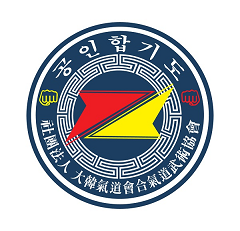
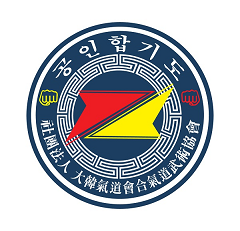
Thus both schools became a single school (Yam Ho Kwan) presided by Gran Master Suh, Seo Lim. That school is about school of the International Korea Kido Association with the following emblem:
Korean Police
The IHF HKD style of Sung Kwang Myung promotes the three martial arts expressions of Hapkido, Hankido, and Hankumdo. Myung Jae Nam studied hapkido with Ji Han Jae, who laid the foundations of this art.In Hankido, the principles of Won (圓, circle), Yu (流, fluidity), and Hwa (和, harmony) are most evident in the application of each technique. To facilitate a deeper understanding of these principles for the Hankido practitioner, there are three exercises that can be practiced, known as Sam Dae Wolly (삼대원리). The exercise representing the principle of the circle is called Jeon Hwan Bob (전환법), the exercise representing the principle of fluidity is called Young Nyu Bob (역류법), and the one representing the principle of harmony is called Shim Hwa Bob (심화법). The latter is also known as the rowing exercise.
The IHF Hapkido schools that originate from Myung Llae, Nam, and the schools that originate from Ji, Han Llae, owe their style to the exquisite treatment of abdominal breathing practice.
International Hapkido Assocciation
Telephone number: x xxx xxx xxx
email:info@hoshin-hapkido.com
© 2026. HoShin-hapkido